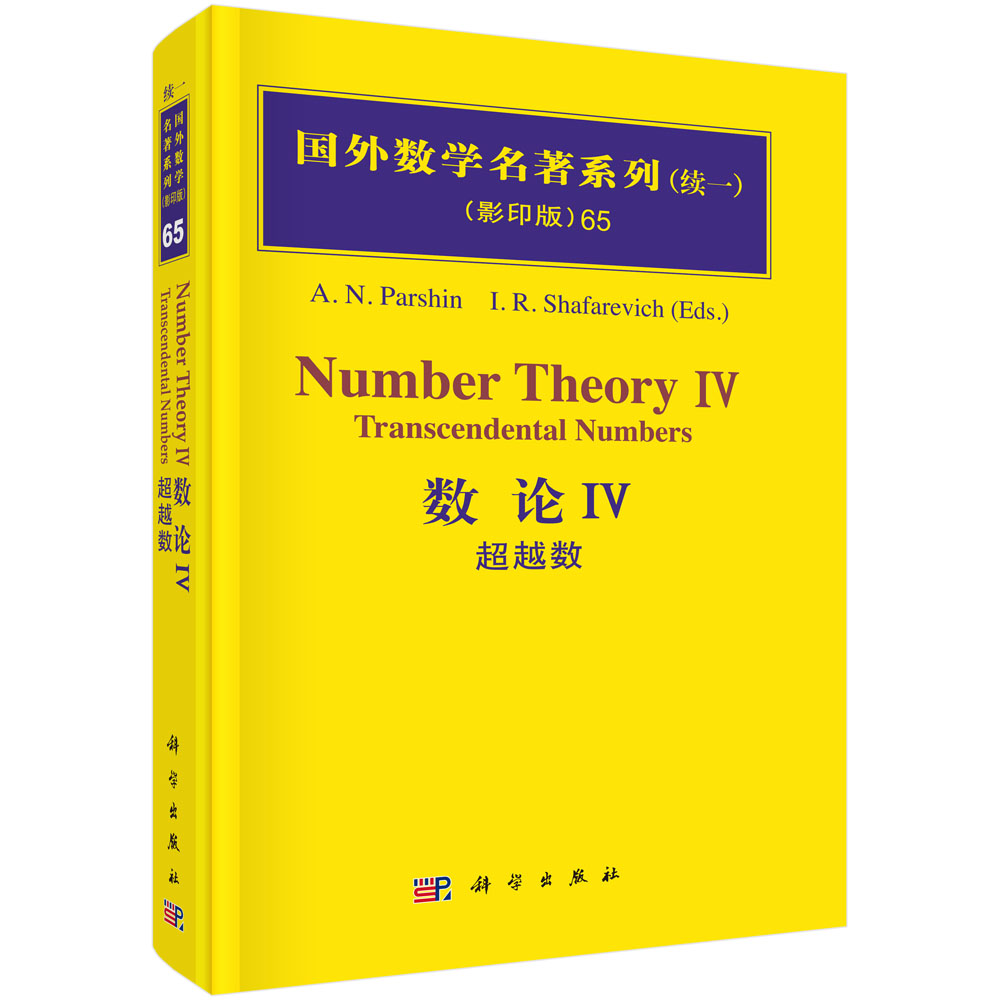
Contents Notation 9 Introduction 11 0.1 Preliminary Remarks 11 0.2 Irrationality of * 11 0.3 The Number π 13 0.4 Transcendental Numbers 14 0.5 Approximation of Algebraic Numbers 15 0.6 Transcendence Questions and Other Branches of Number Theory 16 0.7 The Basic Problems Studied in Transcendental Number Theory 17 0.8 Different Ways of Giving the Numbers 19 0.9 Methods 20 Chapter 1. Approximation of Algebraic Numbers 22 §1. Preliminaries 22 1.1. Parameters for Algebraic Numbers and Polynomials 22 1.2. Statement of the Problem 22 1.3. Approximation of Rational Numbers 23 1.4. Continued Fractions 24 1.5. Quadratic Irrationalities 25 1.6. Liouville's Theorem and Liouville Numbers 26 1.7. Generalization of Liouville's Theorem 27 §2. Approximations of Algebraic Numbers and Thue's Equation 28 2.1. Thue's Equation 28 2.2. The Case n=2 30 2.3. The Case n≥3 30 §3. Strengthening Liouville's Theorem. First Version of Thue's Method 31 3.1. A Way to Bound qθ?p 31 3.2. Construction of Rational Approximations for * 31 3.3. Thue's First Result 32 3.4. Effectiveness 33 3.5. Effective Analogues of Theorem 1.6 34 3.6. The First Effective Inequalities of Baker 36 3.7. Effective Bounds on Linear Forms in Algebraic Numbers 39 §4. Stronger and More General Versions of Liouville's Theorem and Thue's Theorem 40 4.1. The Dirichlet Pigeonhole Principle 40 4.2. Thue's Method in the General Case 41 4.3. Thue's Theorem on Approximation of Algebraic Numbers 44 4.4. The Non-effectiveness of Thue's Theorems 45 §5. Further Development of Thue's Method 45 5.1. Siegel's Theorem 45 5.2. The Theorems of Dyson and Gel'fond 48 5.3. Dyson's Lemma 50 5.4. Bombieri's Theorem 51 §6. Multidimensional Variants of the Thue–Siegel Method 53 6.1. Preliminary Remarks 53 6.2. Siegel's Theorem 53 6.3. The Theorems of Schneider and Mahler 54 §7. Roth's Theorem 55 7.1. Statement of the Theorem 55 7.2. The Index of a Polynomial 56 7.3. Outline of the Proof of Roth's Theorem 57 7.4. Approximation of Algebraic Numbers by Algebraic Numbers 60 7.5. The Number k in Roth's Theorem 61 7.6. Approximation by Numbers of a Special Type 61 7.7. Transcendence of Certain Numbers 62 7.8. The Number of Solutions to the Inequality (62) and Certain Diophantine Equations 63 §8. Linear Forms in Algebraic Numbers and Schmidt's Theorem 65 8.1. Elementary Estimates 65 8.2. Schmidt's Theorem 66 8.3. Minkowski's Theorem on Linear Forms 67 8.4. Schmidt's Subspace Theorem 68 8.5. Some Facts from the Geometry of Numbers 71 §9. Diophantine Equations with the Norm Form 73 9.1. Preliminary Remarks 73 9.2. Schmidt's Theorem 75 §10. Bounds for Approximations of Algebraic Numbers in Non-archimedean Metrics 76 10.1. Mahler's Theorem 76 10.2. The Thue–Mahler Equation 76 10.3. Further Non-effective Results 77 Chapter 2. Effective Constructions in Transcendental Number Theory 78 §1. Preliminary Remarks 78 1.1. Irrationality of e 78 1.2. Liouville's Theorem 79 1.3. Hermite's Method of Proving Linear Independence of a Set of Numbers 80 1.4. Siegel's Generalization of Hermite's Argument 80 1.5. Gel'fond's Method of Proving That Numbers Are Transcendental 82 §2. Hermite's Method 83 2.1. Hermite's Identity 84 2.2. Choice of f(x) and End of the Proof That e is Transcendental 85 2.3. The Lindemann and Lindemann–Weierstrass Theorems 88 2.4. Elimination of the Exponents 90 2.5. End of the Proof of the Lindemann–Weierstrass Theorem 92 2.6. Generalization of Hermite's Identity 92 §3. Functional Approximations 93 3.1. Hermite's Functional Approximation for e^z 93 3.2. Continued Fraction for the Gauss Hypergeometric Function and Padé Approximations 95 3.3. The Hermite–Padé Functional Approximations 98 §4. Applications of Hermite's Simultaneous Functional Approximations 99 4.1. Estimates of the Transcendence Measure of e 99 4.2. Transcendence of e^π 100 4.3. Quantitative Refinement of the Lindemann–Weierstrass Theorem 103 4.4. Bounds for the Transcendence Measure of the Logarithm of an Algebraic Number 104 4.5. Bounds for the Irrationality Measure of π and Other Numbers 106 4.6. Approximations to Algebraic Numbers 110 §5. Bounds for Rational Approximations of the Values of the Gauss Hypergeometric Function and Related Functions 112 5.1. Continued Fractions and the Values of e^z 112 5.2. Irrationality of π 113 5.3. Maier's Results 115 5.4. Further Applications of Padé Approximation 116 5.5. Refinement of the Integrals 120 5.6. Irrationality of the Values of the Zeta-Function and Bounds on the Irrationality Exponent 121 §6. Generalized Hypergeometric Functions 127 6.1. Generalized Hermite Identities 128 6.2. Unimprovable Estimates 131 6.3. Ivankov's Construction 133 §7. Generalized Hypergeometric Series with Finite Radius of Convergence 136 7.1. Functional Approximations of the First Kind 136 7.2. Functional Approximations of the Second Kind 139 §8. Remarks 143 Chapter 3. Hilbert's Seventh Problem 146 §1. The Euler–Hilbert Problem 146 1.1. Remarks by Leibniz and Euler 146 1.2. Hilbert's Report 146 §2. Solution of Hilbert's Seventh Problem 147 2.1. Statement of the Theorems 147 2.2. Gel'fond's Solution 147 2.3. Schneider's Solution 149 2.4. The Real Case 150 2.5. Laurent's Method 151 §3. Transcendence of Numbers Connected with Weierstrass Functions 152 3.1. Preliminary Remarks 152 3.2. Schneider's Theorems 153 3.3. Outline of Proof of Schneider's Theorems 155 §4. General Theorems 157 4.1. Schneider's General Theorems 157 4.2. Consequences of Theorem 3.17 158 4.3. Lang's Theorem 159 4.4. Schneider's Work and Later Results on Abelian Functions 159 §5. Bounds for Linear Forms with Two Logarithms 161 5.1. First Estimates for the Transcendence Measure of ab and ln α/ln β 161 5.2. Refinement of the Inequalities (19) and (20) Using Gel'fond's Second Method 163 5.3. Bounds for Transcendence Measures 164 5.4. Linear Forms with Two Logarithms 164 5.5. Generalizations to Non-archimedean Metrics 165 5.6. Applications of Bounds on Linear Forms in Two Logarithms 165 §6. Generalization of Hilbert's Seventh Problem to Liouville Numbers 172 6.1. Ricci's Theorem 172 6.2. Later Results 173 §7. Transcendence Measure of Some Other Numbers Connected with the Exponential Function 173 7.1. Logarithms of Algebraic Numbers 173 7.2. Approximation of Roots of Certain Transcendental Equations 175 §8. Transcendence Measure of Numbers Connected with Elliptic Functions 176 8.1. The Case of Algebraic Invariants 176 8.2. The Case of Algebraic Periods 177 8.3. Values of ?(z) at Non-algebraic Points 177 Chapter 4. Multidimensional Generalization of Hilbert's Seventh Problem 179 §1. Linear Forms in the Logarithms of Algebraic Numbers 179 1.1. Preliminary Remarks 179 1.2. The First Effective Theorems in the General Case 180 1.3. Baker's Method 182 1.4. Estimates for the Constant in (8) 185 1.5. Methods of Proving Bounds for Λ, Λ?, and Λ? 187 1.6. A Special Form for the Inequality 188 1.7. Non-archimedean Metrics 188 §2. Applications of Bounds on Linear Forms 189 2.1. Preliminary Remarks 189 2.2. Effectivization of Thue's Theorem 189 2.3. Effective Strengthening of Liouville's Theorem 192 2.4. The Thue–Mahler Equation 193 2.5. Solutions in Special Sets 194 2.6. Catalan's Equation 195 2.7. Some Results Connected with Fermat's Last Theorem 196 2.8. Some Other Diophantine Equations 197 2.9. The abc-Conjecture 199 2.10. The Class Number of Imaginary Quadratic Fields 199 2.11. Applications in Algebraic Number Theory 200 2.12. Recursive Sequences 201 2.13. Prime Divisors of Successive Natural Numbers 203 2.14. Dirichlet Series 203 §3. Elliptic Functions 204 3.1. The Theorems of Baker and Coates 204 3.2. Masser's Theorems 204 3.3. Further Results 205 3.4. Wüstholz's Theorems 206 §4. Generalizations of the Theorems in §1 to Liouville Numbers 207 4.1. Walliser's Theorems 207 4.2. Wüstholz's Theorems 207 Chapter 5. Values of Analytic Functions That Satisfy Linear Differential Equations 209 §1. E-Functions 209 1.1. Siegel's Results 209 1.2. Definition of E-Functions and Hypergeometric E-Functions 210 1.3. Siegel's General Theorem 213 1.4. Shidlovskii's Fundamental Theorem 214 §2. The Siegel–Shidlovskii Method 215 2.1. A Technique for Proving Linear and Algebraic Independence 215 2.2. Construction of a Complete Set of Linear Forms 218 2.3. Nonvanishing of the Functional Determinant 219 2.4. Concluding Remarks 221 §3. Algebraic Independence of the Values of Hypergeometric E-Functions 222 3.1. The Values of E-Functions That Satisfy First, Second, and Third Order Differential Equations 222 3.2. The Values of Solutions of Differential Equations of Arbitrary Order 225 §4. The Values of Algebraically Dependent E-Functions 229 4.1. Theorem on Equality of Transcendence Degree 230 4.2. Exceptional Points 231 §5. Bounds for Linear Forms and Polynomials in the Values of E-Functions 234 5.1. Bounds for Linear Forms in the Values of E-Functions 234 5.2. Bounds for the Algebraic Independence Measure 237 §6. Bounds for Linear Forms that Depend on Each Coefficient 241 6.1. A Modification of Siegel's Scheme 241 6.2. Baker's Theorem and Other Concrete Results 243 6.3. Results of a General Nature 244 §7. G-Functions and Their Values 246 7.1. G-Functions 246 7.2. Canceling Factorials 250 7.3. Arithmetic Type 252 7.4. Global Relations 253 7.5. Chudnovsky's Results 255 Chapter 6. Algebraic Independence of the Values of Analytic Functions That Have an Addition Law 259 §1. Gel'fond's Method and Results 260 1.1. Gel'fond's Theorems 261 1.2. Bound for the Transcendence Measure 262 1.3. Gel'fond's "Algebraic Independence Criterion" and the Plan of Proof of Theorem 6.3 264 1.4. Further Development of Gel'fond's Method 267 1.5. Fields of Finite Transcendence Type 268 §2. Successive Elimination of Variables 271 2.1. Small Bounds on the Transcendence Degree 271 2.2. An Inductive Procedure 272 §3. Applications of General Elimination Theory 276 3.1. Definitions and Basic Facts 276 3.2. Philippon's Criterion 278 3.3. Direct Estimates for Ideals 284 3.4. Effective Hilbert Nullstellensatz 287 §4. Algebraic Independence of the Values of Elliptic Functions 290 4.1. Small Bounds for the Transcendence Degree 291 4.2. Elliptic Analogues of the Lindemann–Weierstrass Theorem 295 4.3. Elliptic Generalizations of Hilbert's Seventh Problem 296 §5. Quantitative Results 302 5.1. Bounds on the Algebraic Independence Measure 302 5.2. Bounds on Ideals, and the Algebraic Independence Measure 304 5.3. The Approximation Measure 306 Bibliography 309 Index 344














 京公网安备 11010102004214号