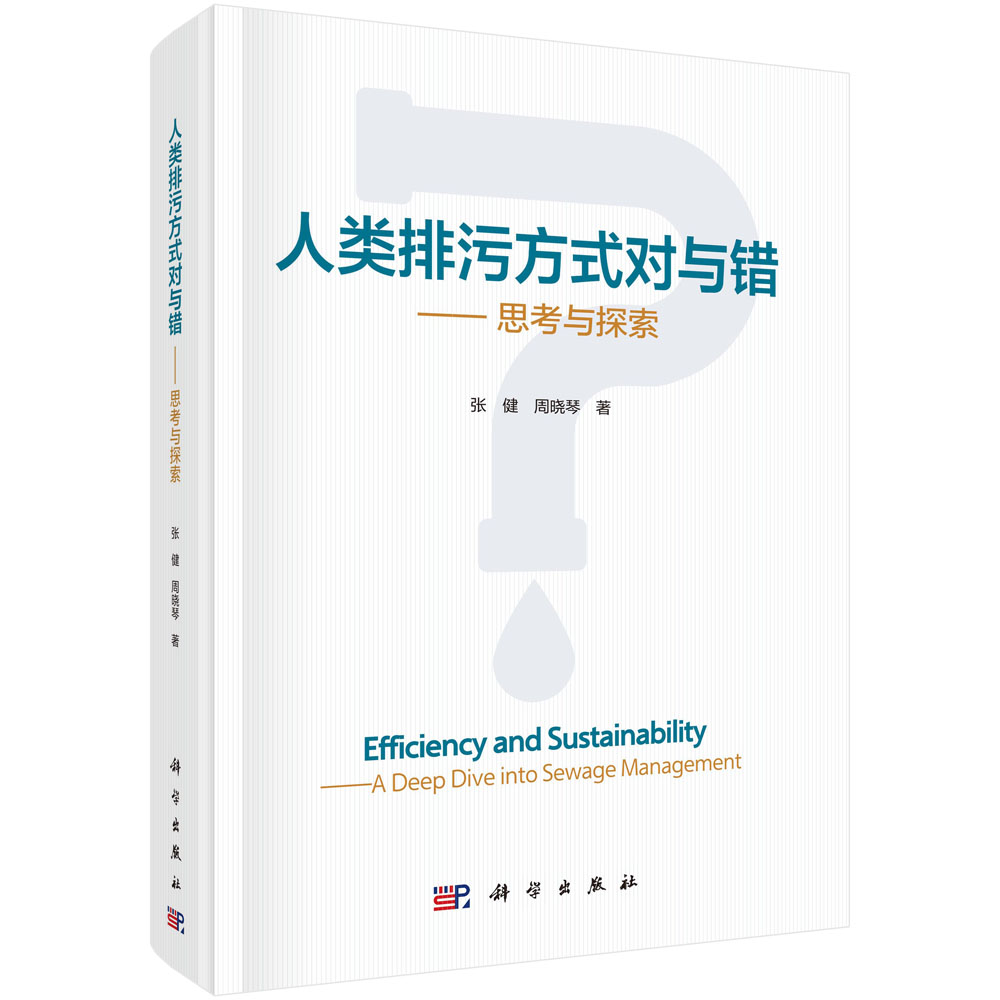
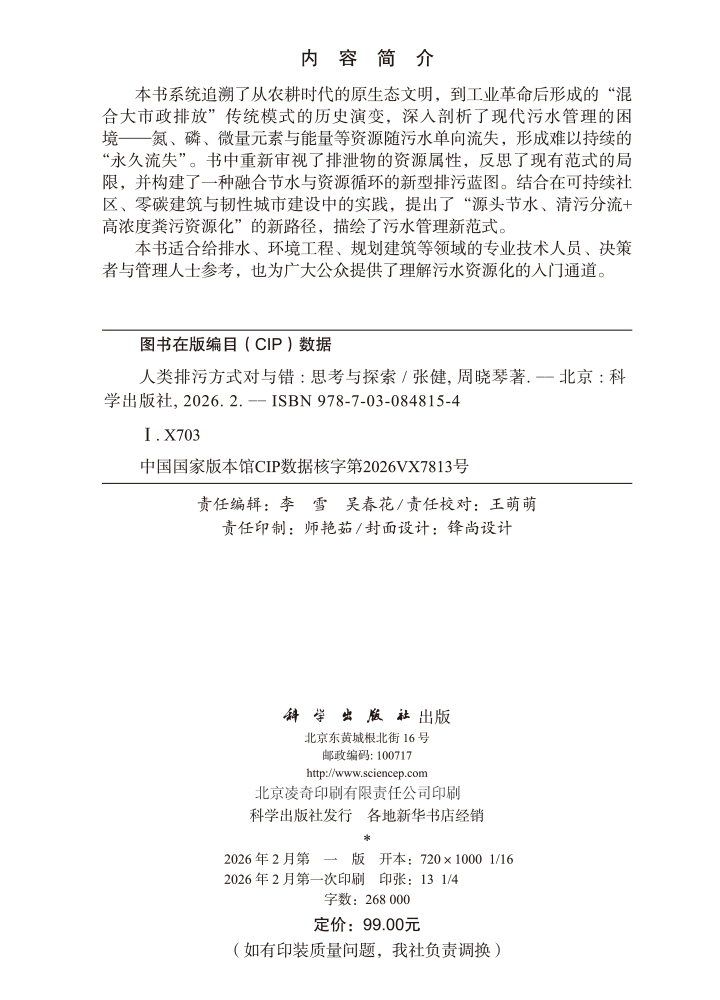
本书系统追溯了从农耕时代的原生态文明,到工业革命后形成的“混合大市政排放”传统模式的历史演变,深入剖析了现代污水管理的困境——氮、磷、微量元素与能量等资源随污水单向流失,形成难以持续的“永久流失”。书中重新审视了排泄物的资源属性,反思了现有范式的局限,并构建了一种融合节水与资源循环的新型排污蓝图。结合在可持续社区、零碳建筑与韧性城市建设中的实践,提出了“源头节水、清污分流+高浓度粪污资源化”的新路径,描绘了污水管理新范式。
样章试读
目录
- 目录
第1章 当今全球流行的污水管理范式是怎么来的? 001
1.1 早期的厕所/002
1.2 农耕文明–粪尿农用/005
1.3 大规模建设下水道/007
1.4 排泄物排入水体与水污染/009
1.5 排泄物排入水体遭到过抵制/010
1.6 下水道成为粪污管理的范式/013
第2章 漫长的污水控制之路 017
2.1 卫生工程——饮用水水质改善/018
2.2 卫生工程——污水稳定化处理/020
2.3 卫生工程——下水道雨污分流/021
2.4 卫生工程——污泥稳定化/023
2.5 后卫生工程时代——增加营养物氮磷的削减/026
2.6 后卫生工程时代——受纳水体的富营养化修复/028
2.7 后卫生工程时代——生产再生水/030
2.8 后卫生工程时代——可持续发展新要求/030
2.9 漫长的认知过程/033
第3章 对排泄物和污水的再认识 035
3.1 排泄物溯源/036
3.2 生活污水溯源/038
3.3 排泄物是资源/042
第4章 对既有范式的反思 045
4.1 既有范式在全球范围难以普及/046
4.2 从污水组成反思既有范式的合理性/048
4.3 从水资源高效利用看既有范式的弊端/048
4.4 从环境与生态影响反思合理性/050
4.5 既有范式捆绑和约束了创新/051
4.6 决策缺少可选择的替代方案和经验/052
第5章 梦想 055
5.1 目标/056
5.2 愿景/057
5.3 从厕所启程/058
5.4 以资源化为导向的排泄物收集/060
5.5 迈向无废时代/064
第6章 未来社区的水基础设施 067
6.1 概念示范/068
6.2 社区水基础设施新方案/072
6.3 超大社区及规模化应用/078
6.4 摆脱大市政下水道的城市开发/085
第7章 面向零碳建筑的水管理 089
7.1 目标和意义/090
7.2 探索与实践/092
7.3 公厕=资源工厂?/100
第8章 黄水源分离资源化实施方式探索 103
8.1 黄水源头收集/104
8.2 一个全球最大规模的试验——高密度多层建筑应用黄水分离堆肥厕所/106
8.3 奥林匹克森林公园的绿色实践——资源原位利用的尿液分离水冲厕所/112
8.4 关于黄水分离的思考与总结/116
第9章 过去、现在和将来 121
9.1 回头看/122
9.2 老城改造/124
9.3 乡村振兴/127
9.4 挑战与转变/129
第10章 社会环境效益的分析比较 135
10.1 路由与过程的脚印/136
10.2 物质流/137
10.3 能量流及碳减排/139
10.4 能量回收与碳补偿/144
10.5 资源回收与碳补偿/147
第11章 费用的比较 151
11.1 最常遇到的质疑/152
11.2 一个早期的费用比较/154
11.3 关于排泄物的潜在肥料价值/161
第12章 新的选择 163
12.1 源头管理/164
12.2 分质收集/167
12.3 分散与分散组团/170
12.4 以资源化为导向的终端处理/172
附录 污水源分离工程设计技术要点 175
附1 污水源头分质管理/176
附2?负压收集技术基本原理/179
附3?收集管网/181
后记 189
Contents
Chapter 1 How Did the Prevailing Global Wastewater Management Paradigm Form? 001
1.1 Early Toilets/002
1.2 Agricultural Civilization-Use of Excreta/005
1.3 Large-Scale Sewer Construction/007
1.4 Discharge of Excreta into Water Bodies and Water Pollution/009
1.5 Resistance Against Discharging Excreta into Water Bodies/010
1.6 Sewers Become the Paradigm for Fecal Sludge Management/013
Chapter 2 The Long Journey of Wastewater Control 017
2.1 Sanitary Engineering-Drinking Water Quality Improvement/018
2.2 Sanitary Engineering-Wastewater Stabilization/020
2.3 Sanitary Engineering-Stormwater Separation/021
2.4 Sanitary Engineering-Sludge Stabilization/023
2.5 Post-Sanitary Engineering-Reduction of Nutrients (Nitrogen and Phosphorus)/026
2.6 Post-Sanitary Engineering-Remediation of Eutrophication/028
2.7 Post-Sanitary Engineering-Production of Reclaimed Water/030
2.8 Post-Sanitary Engineering-New Requirements for Sustainability/030
2.9 A Long Process of Cognition/033
Chapter 3 Re-evaluating Excreta and Wastewater 035
3.1 Tracing the Source of Human Excreta/036
3.2 Tracing the Source of Domestic Wastewater/038
3.3 Excreta is Resource/042
Chapter 4 Rethink on the Existing Paradigm 045
4.1 Difficulty in Global Adoption of the Existing Paradigm/046
4.2 The Reflection of the Existing Paradigm Based on Wastewater Composition/048
4.3 Water Resource Efficiency of the Existing Paradigm/048
4.4 Reflection on Environmental and Ecological Impacts/050
4.5 The Existing Paradigm Hinders and Constrains Innovation/051
4.6 Lack of Alternatives and Paradigms for Decision-Making/052
Chapter 5 The Dream 055
5.1 Objectives/056
5.2 Vision/057
5.3 Starting with the Toilet/058
5.4 Resource-Oriented Excreta Collection/060
5.5 Towards Zero-discharge/064
Chapter 6 Water Infrastructure for Future Communities 067
6.1 Conceptual Demonstration/068
6.2 New Approaches for Community Water Infrastructure/072
6.3 Ultra-Large Communities and Scalable Application/078
6.4 Non-Municipal Sewers Urban Development/085
Chapter 7 Water Management for Zero-Carbon Buildings 089
7.1 Goals and Significance/090
7.2 Exploration and Practice/092
7.3 Public Toilets = Resource Factories?/100
Chapter 8 Exploring the Paths for Resource Recovery by Urine Separation 103
8.1 Collecting Urine at Source/104
8.2 A Globally largest Trial-Application of Urine-separating Composting Toilets in High-Density Multi-Story Buildings/106
8.3 Green Practice at Olympic Forest Park-Urine-Separating Flush Toilets and On-Site Resource Utilization/112
8.4 Reflections and Summary/116
Chapter 9 Past, Present, and Future 121
9.1 Backwards/122
9.2 Old City upgradation/124
9.3 Rural Revitalization/127
9.4 Challenges and Transformation/129
Chapter 10 Analysis and Comparison of Socio-Environmental Benefits 135
10.1 Tracking the Path and Process/136
10.2 Mass Flow/137
10.3 Energy Flow and Carbon Reduction/139
10.4 Energy Recovery and Carbon Offset/144
10.5 Resource Recovery and Carbon Offset/147
Chapter 11 Cost Comparison 151
11.1 The Most Common Skepticism/152
11.2 An Early Cost Comparison/154
11.3 The Potential Value of Human Excreta-derived Fertilizer/161
Chapter 12 New Choices 163
12.1 Source Management/164
12.2 Semi-Centralized Collection/167
12.3 Decentralized and Clustered Decentralized Systems/170
12.4 Resource-Oriented Treatment/172
Appendix: Key Technical Points for Engineering Design of Source Separation 175
1 Source Quality Management of Wastewater/176
2 Basic Principles of Vacuum Collection Technology/179
3 Collection Pipe Network/181
Afterword 187












 京公网安备 11010102004214号