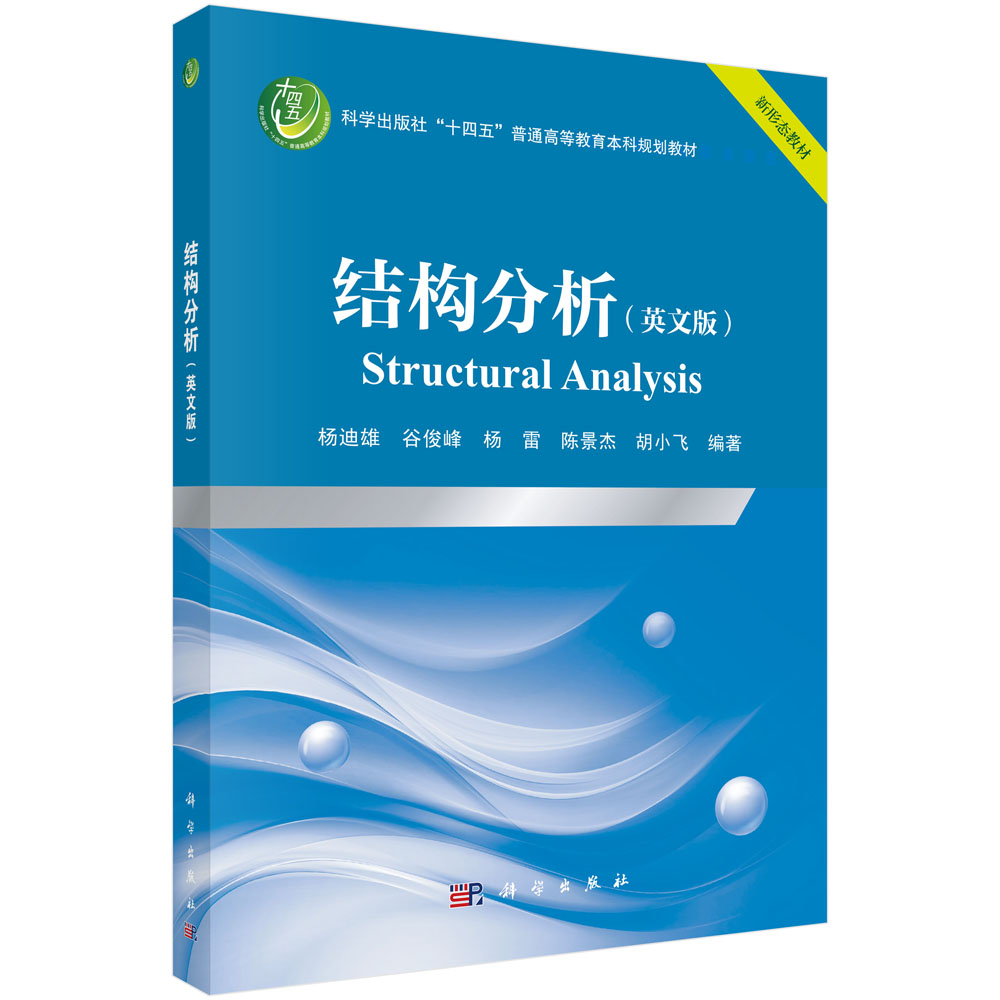
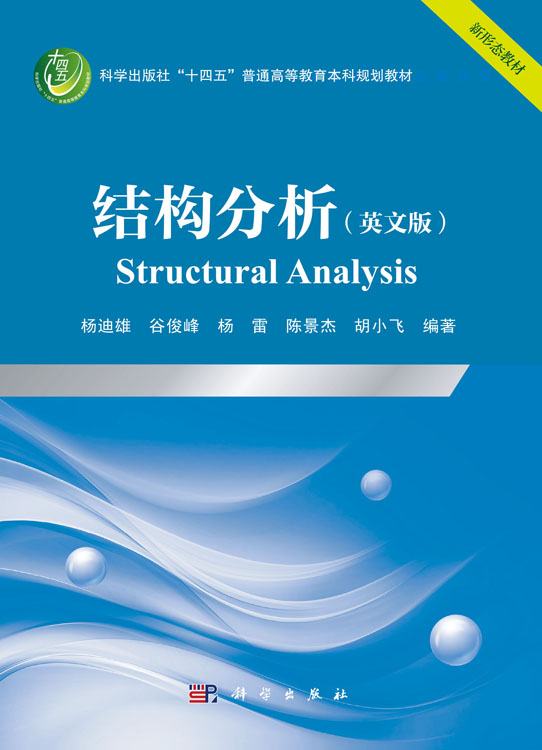
Contents Chapter 1 Introduction 1 1.1 Research Object and Tasks of Structural Analysis 1 1.1.1 Research Object 1 1.1.2 Tasks 3 1.2 Computational Models of Structures 4 1.2.1 Simplification of Structural Systems 5 1.2.2 Simplification of Members 5 1.2.3 Simplification of Joints 5 1.2.4 Simplification of Supports 6 1.2.5 Simplification of Material Properties 7 1.2.6 Simplification of Loads 7 1.3 Classification of Member Structures and Loads 8 1.3.1 Classification of Member Structures 8 1.3.2 Classification of Loads 10 1.4 A Brief History of the Development of Structural Analysis 11 1.4.1 Energy Principles and Energy Methods 11 1.4.2 Force Method and Displacement Method 13 1.4.3 Matrix Displacement Method and Finite Element Method 16 1.4.4 A Brief Introduction to Important Figures in Structural Analysis 19 Chapter 2 Kinematic Analysis of Planar Member Systems 23 2.1 Several Concepts of Kinematic Analysis 24 2.1.1 Degree of Freedom and Constraint 24 2.1.2 Instantaneously Changeable System and Constantly Changeable System 26 2.1.3 Instantaneous Hinge 27 2.2 Basic Construction Rules of Geometrically Unchangeable Plane Systems 28 2.2.1 Rule of Pin Joined Member System 28 2.2.2 Rule of Two Rigid Discs 28 2.2.3 Rule of Three Rigid Discs 29 2.3 Computational Degree of Freedom of Planar Member Systems 34 2.3.1 Computational Degree of Freedom of Rigid Disc System 35 2.3.2 Computational Degree of Freedom of Hinged System 36 2.3.3 Computational Degree of Freedom of Mixed System 37 2.4 Geometrical Stability and Static Determinacy of Systems 39 Problems 40 Chapter 3 Analysis of Statically Determinate Structures 43 3.1 Single Span Statically Determinate Beams 44 3.1.1 Single Span Statically Determinate Beams and Internal Forces 44 3.1.2 Relations Between Loads and Internal Forces 45 3.1.3 Method of Segmental Superposition 47 3.2 Multi Span Statically Determinate Beams 50 3.3 Statically Determinate Plane Trusses 55 3.3.1 Characteristics and Classification of Trusses 55 3.3.2 Method of Joints 57 3.3.3 Method of Sections 60 3.3.4 Combined Application of the Method of Joints and the Method of Sections 62 3.4 Statically Determinate Plane Frames 64 3.4.1 Characteristics of Frames 64 3.4.2 Calculation of Support Reactions 64 3.4.3 Internal Force Analysis and Drawing Internal Force Diagram of Frames 67 3.4.4 Quick Drawing of Moment Diagrams of Statically Determinate Frames 75 3.5 Statically Determinate Composite Structures 78 3.6 Three Hinged Arches 82 3.6.1 Support Reactions and Internal Force Calculation of Three Hinged Arches 83 3.6.2 Rational Axes of Three Hinged Arches 88 3.7 General Properties of Statically Determinate Structures 92 Problems 95 Chapter 4 Principle of Virtual Work and Deflection Calculation 101 4.1 Overview of Deflection Calculation 101 4.1.1 Concept of Structural Displacements 101 4.1.2 Purpose of Deflection Calculation 102 4.2 Principle of Virtual Work for Deformable Structures 103 4.2.1 Principle of Virtual Work for Rigid Body System 103 4.2.2 Application Conditions of Principle of Virtual Work for Deformable Structures 104 4.2.3 Virtual Work Equation for Deformable Structures 106 4.2.4 Principle of Virtual Forces and Principle of Virtual Displacements 109 4.3 Unit Load Method for Structural Deflection Calculation 110 4.4 Deflection Calculation under Loads 113 4.4.1 Formula for Deflection Calculation under Loads 113 4.4.2 Deflection Formulas for Various Structures 115 4.4.3 Examples of Deflection Calculation under Loads 116 4.5 Graph Multiplication Method 121 4.5.1 Graph Multiplication Method and Its Application Conditions 121 4.5.2 Several Specific Problems of Applying Graph Multiplication Method 122 4.5.3 Examples of Graph Multiplication Method 124 4.6 Deflection Calculation under Temperature Change 127 4.7 Reciprocal Theorems of Linearly Elastic Structures 129 4.7.1 Theorem of Reciprocal Works 130 4.7.2 Theorem of Reciprocal Displacements 131 4.7.3 Theorem of Reciprocal Reactions 132 4.7.4 Theorem of Reciprocal Displacement Reaction 133 Problems 134 Chapter 5 Force Method 138 5.1 Determination of Degree of Static Indeterminacy 139 5.1.1 Equilibrium and Geometric Construction Characteristics of Statically Indeterminate Structures 139 5.1.2 Determination of Degree of Indeterminacy and Number of Redundant Constraint Forces 139 5.2 Fundamental Concept of the Force Method 141 5.2.1 Primary Unknowns, Primary System, and Basic Equations of Force Method 142 5.2.2 Analysis of Structures with Multiple Degrees of Indeterminacy by Force Method 145 5.2.3 Canonical Equations of Force Method 147 5.3 Analysis of Statically Indeterminate Frames and Bent Structures 149 5.4 Analysis of Statically Indeterminate Trusses and Composite Structures 157 5.5 Analysis of Symmetric Structures and Half Structures 161 5.5.1 Selection of Symmetric Primary System 164 5.5.2 Determination of Half Structure in Terms of Symmetry 167 5.6 Two Hinged and Hingeless Arches 172 5.6.1 Solving Two Hinged Arch by the Force Method 173 5.6.2 Solving Hingeless Arch by the Force Method 178 5.7 Internal Force Analysis of Structures under Support Movement or Temperature Change 182 5.7.1 Support Movement 182 5.7.2 Temperature Change 185 5.8 Deflection Computation of Statically Indeterminate Structures 188 5.9 Check for Calculated Results of Statically Indeterminate Structures 192 5.9.1 Check of Equilibrium Conditions 193 5.9.2 Check of Deformation Conditions 194 Problems 195 Chapter 6 Displacement Method 199 6.1 Fundamental Concept of the Displacement Method 200 6.1.1 A Simple Example of Displacement Method 200 6.1.2 Primary Unknowns and Basic Equations of Displacement Method 203 6.1.3 Basic Idea of Calculating Frame Structures by Displacement Method 203 6.1.4 Determination of Primary Unknowns of Displacement Method 204 6.2 Slope Deflection Equation of Prismatic Member 208 6.2.1 Calculating Member End Internal Forces from Member End Displacements 210 6.2.2 Calculating Fixed End Internal Forces from Loads 212 6.3 Analysis of Frames without Sidesway 215 6.3.1 Selection of Primary Unknowns 215 6.3.2 Establishment of Basic Equations 216 6.4 Analysis of Frames with Sidesway 218 6.5 Analysis of Symmetric Structures 225 6.6 Primary System in the Displacement Method 228 6.6.1 Primary System of the Displacement Method 229 6.6.2 Basic Equations of the Displacement Method 229 6.6.3 Process of Establishing Basic Equations of the Displacement Method 231 6.6.4 Canonical Equations of Displacement Method 233 6.7 Principle of Potential Energy and Displacement Method 235 6.7.1 Principle of Stationary Potential Energy 235 6.7.2 Linear Elastic Strain Energy of Prismatic Member 237 6.7.3 Principle of Potential Energy and Equilibrium Equation of Displacement Method 238 6.8 Rayleigh Ritz Method 242 6.9 Moment Distribution Method and No Shear Moment Distribution Method 244 6.9.1 Basic Principle of the Moment Distribution Method 244 6.9.2 Computation of Continuous Beams and Frames without Sidesway Using the Moment Distribution Method 249 6.9.3 No Shear Moment Distribution Method 255 6.10 Characteristics of Statically Indeterminate Structures 260 Problems 261 Chapter 7 Influence Lines for Structures under Moving Loads 266 7.1 Concepts of Moving Load and Influence Line 267 7.2 Equilibrium Method for Constructing Influence Lines of Simply Supported Beams 269 7.3 Influence Lines for Girders and Trusses 273 7.3.1 Influence Lines for Internal Forces of Girders 273 7.3.2 Influence Lines for Axial Forces of Trusses 276 7.4 Kinematic Method for Constructing Influence Lines of Statically Determinate Structures 280 7.5 Applications of Influence Lines 286 7.5.1 Responses Due to Various Kinds of Loads 287 7.5.2 Most Unfavorable Position of Moving Loads 288 7.5.3 Determination of Critical Position for Polygonal Influence Line 290 7.5.4 Determination of Critical Position for Triangle Influence Line 293 7.6 Kinematic Method for Constructing Influence Lines of Statically Indeterminate Beams 296 Problems 303 Chapter 8 Matrix Displacement Method 307 8.1 Fundamental Principle of the Matrix Displacement Method 308 8.2 Elemental Stiffness Matrix 309 8.2.1 Elemental Stiffness Matrix in Local Coordinate System 309 8.2 Elemental Stiffness Matrix 309 8.2.1 Elemental Stiffness Matrix in Local Coordinate System 309 8.2.2 Properties of Elemental Stiffness Matrix 312 8.3 Coordinate Transformation of Elemental Stiffness Matrix 313 8.3.1 Elemental Stiffness Matrix in Global Coordinate System 313 8.3.2 Elemental Stiffness Matrix of Continuous Beam 316 8.3.3 Elemental Stiffness Matrix of Axial Force Bar 318 8.4 Global Stiffness Matrix of Structure 321 8.4.1 Element and Node Numberings 321 8.4.2 Direct Stiffness Method for Assembling Global Stiffness Matrix 322 8.4.3 Imposing Support Conditions 325 8.4.4 Properties of Global Stiffness Matrix 326 8.4.5 Treatment of Pinned Joints 326 8.5 Equivalent Nodal Loads 327 8.5.1 Basic Equation of Matrix Displacement Method 327 8.5.2 Equivalent Nodal Loads of Elements 327 8.5.3 Equivalent Nodal Loads of Structure 329 8.6 Computational Procedures and Examples 331 8.6.1 Example of Truss Analysis 332 8.6.2 Example of Frame Structure 336 8.6.3 Example of Composite Structure 342 8.6.4 Matrix Displacement Method for Rectangular Frame Neglecting Axial Deformation 346 Problems 348 Bibliography 351 Appendix A1 Answers to Problems 352 Appendix A2 Index 359 Appendix A3 Matlab Program Codes of the Matrix Displacement Method for Planar Structural Analysis 362

























 京公网安备 11010102004214号