0去购物车结算
购物车中还没有商品,赶紧选购吧!
当前位置: > Modeling in Life Sciences and Ecology Machine Learning and Dynamical Systems(生命科学与生态学中的建模:机器学习与动力系统)


销售排行榜

浏览历史

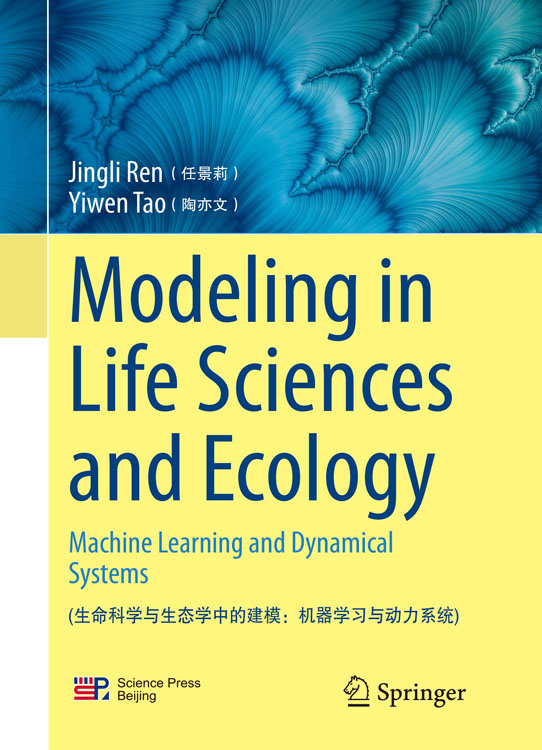
Modeling in Life Sciences and Ecology Machine Learning and Dynamical Systems(生命科学与生态学中的建模:机器学习与动力系统)



联系编辑
 
标题:
 
内容:
 
联系方式:
 
  
Modeling in Life Sciences and Ecology Machine Learning and Dynamical Systems(生命科学与生态学中的建模:机器学习与动力系统)

  • 书号:9787030812506
    作者:任景莉,陶亦文
  • 外文书名:
  • 装帧:平装
    开本:B5
  • 页数:312
    字数:
    语种:en
  • 出版社:科学出版社
    出版时间:2026-06-01
  • 所属分类:
  • 定价: ¥168.00元
    售价: ¥132.72元
  • 图书介质:
    纸质书

  • 购买数量: 件  可供
  • 商品总价:

相同系列
全选

内容介绍

样章试读

用户评论

全部咨询

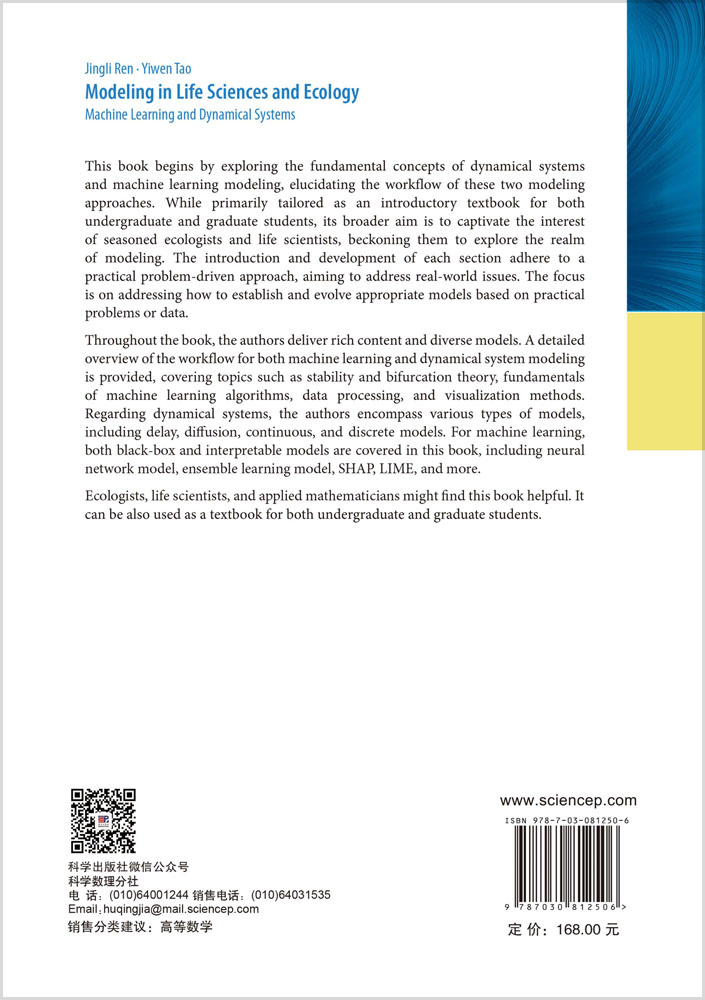
This book covers a wide range of modeling tools, including cutting-edge machine learning and classical dynamical systems, to solve data- and hypothesis-driven in ecology and life sciences. The proposed book (1) provides a unified and coherent account of the methods developed for studying ecology and life sciences through dynamical systems and machine learning. (2) provides the reader with the tools to construct and interpret models. (3) includes specific applications of the models and methods described. (4) advances the stability theory by proposing a new framework for generalized systems.
样章试读
  • 暂时还没有任何用户评论
总计 0 个记录,共 1 页。 第一页 上一页 下一页 最末页

全部咨询(共0条问答)

  • 暂时还没有任何用户咨询内容
总计 0 个记录,共 1 页。 第一页 上一页 下一页 最末页
用户名: 匿名用户
E-mail:
咨询内容:

目录

  • Contents
    1 Introduction to Dynamical Systems 1
    1.1 Definition of a Dynamical System 1
    1.1.1 State Space 1
    1.1.2 Time 2
    1.1.3 Evolution Operator 2
    1.1.4 Dynamic System 4
    1.1.5 Steady State 7
    1.2 Bifurcations in Dynamical System 8
    1.2.1 Bifurcation in Continuous System 9
    1.2.2 Bifurcation in Discrete System 9
    1.2.3 Bifurcation of Limit Cycle 10
    1.3 Normal Forms for Bifurcations 12
    1.3.1 Center Manifold Theorem 13
    1.3.2 Normal Forms for Bifurcations in Continuous System 15
    1.3.3 Normal Forms for Bifurcations in Discrete System 19
    1.4 Application of Dynamical Systems 24
    2 Introduction of Machine Learning 27
    2.1 Machine Learning Concept, Category, and Workflow 27
    2.1.1 Concept and Category 27
    2.1.2 Basic Workflow 30
    2.2 Several Classical Machine Learning Algorithms 31
    2.2.1 Decision Tree 31
    2.2.2 Ensemble Learning 33
    2.2.3 Extremely Randomized Trees 39
    2.2.4 Support Vector Machine 41
    2.2.5 K-Nearest Neighbor 43
    2.2.6 Gaussian Naive Bayes 44
    2.2.7 Multilayer Perceptron 46
    2.3 Model Evaluation 48
    2.3.1 Evaluation Methods for Regression 49
    2.3.2 Evaluation Methods for Classification 51
    2.3.3 Example Evaluation Methods for Survival Analysis Model 55
    2.4 Feature Selection 56
    2.4.1 Filter Method 56
    2.4.2 Wrapper Method 59
    2.4.3 Embedded Method 61
    2.5 The Issue of Imbalanced Data and Its Solutions 64
    2.5.1 Data-Level Approaches 64
    2.5.2 Algorithmic (Loss Function) Level Approaches 66
    2.6 Model Interpretation 68
    2.6.1 Feature Importance 69
    2.6.2 Variance Inflation Factor 71
    2.6.3 Partial Dependence Plot 73
    2.6.4 Accumulated Local Effect 75
    2.6.5 Local Interpretable Model-Agnostic Explanation 78
    2.6.6 Shapley Additive Explanations 81
    2.7 Application of Machine Learning 84
    3 Ecological Modeling with Nonlocal Delay 87
    3.1 Dynamics of a Diffusive Plankton Model with Nonlocal Delays 88
    3.1.1 NPZ Model with Nonlocal Delays 88
    3.1.2 Local Stability of a Generalized Reaction-Diffusion Problem 93
    3.1.3 Local Stability of the NPZ Model 101
    3.1.4 Global Behavior of the NPZ Model 108
    3.1.5 Conclusion 119
    3.2 Dynamics of a Diffusive Predator-Prey Model with Nonlocal Delays 120
    3.2.1 Rosenzweig-MacArthur Model with Nonlocal Delays 123
    3.2.2 Local Stability of the Rosenzweig-MacArthur Model 125
    3.2.3 Global Behavior of the Rosenzweig-MacArthur Model 129
    3.2.4 Conclusion 137
    4 Physiological Modeling with Dynamic Systems 139
    4.1 Dynamics of a Glucose Regulatory Model 140
    4.1.1 Glucose-Insulin-β-Cell System 140
    4.1.2 Bifurcation Analysis of the GIβ System 141
    4.2 Dynamics of Perturbed Glucose Regulatory System 156
    4.2.1 Approach to Investigation 156
    4.2.2 Bifurcation Analysis with Synchronous Perturbations 158
    4.2.3 Bifurcation Analysis with Nonsynchronous Perturbations 161
    4.2.4 Solutions and Chaos of the GIβ System 163
    4.2.5 Conclusion 165
    5 Machine Learning in Clinical Medicine 167
    5.1 Predicting Mortality Risk in Rheumatic Heart Disease Patients 167
    5.1.1 Data Preprocessing 168
    5.1.2 Feature Selection 172
    5.1.3 Data- and Algorithm-Driven Modeling 173
    5.1.4 Model Evaluation and Selection 183
    5.1.5 Model Interpretation 187
    5.1.6 Conclusion 193
    5.2 Survival Analysis of Breast Cancer Patients 194
    5.2.1 Data Source and Extraction 194
    5.2.2 Predictive Model of Breast Cancer Survival 196
    5.2.3 Model Optimization and Evaluation 204
    5.2.4 Global and Individual Survival Analysis Interpretations 205
    5.2.5 Conclusion 208
    6 Machine Learning in Drug Discovery 209
    6.1 Prediction of Drugs-HPV Target Proteins Interaction 209
    6.1.1 Data Collection and Configuration 210
    6.1.2 Construction of Negative Drug-Target Pairs 212
    6.1.3 Predictive Model for Drug-Target Protein Interactions 218
    6.1.4 Model Construction and Evaluation 221
    6.1.5 Model Evaluation 225
    6.1.6 Conclusion 227
    6.2 Omics-Informed Prediction of Anticancer Drug Response 227
    6.2.1 Data Collection and Preprocessing 228
    6.2.2 Modeling of Anticancer Drug Response 232
    6.2.3 Conclusion 235
    7 Machine Learning in Ecology 237
    7.1 Quantifying Drivers of Air Quality Change 237
    7.1.1 Data Collection and Processing 239
    7.1.2 Modeling of Air Quality Index 240
    7.1.3 Quantifying Drivers at Global Levels 246
    7.1.4 Quantifying Drivers at Local Levels 249
    7.1.5 Conclusion 251
    7.2 Prediction of Algal Growth Tendency 252
    7.2.1 Study Area and Dataset 253
    7.2.2 Predictive Model of Algae Density 253
    7.2.3 Analysis of Algae Growth Mechanism 254
    7.2.4 Conclusion 259
    8 Spatiotemporal Environmental Health Modeling 261
    8.1 Mechanism-Based and Machine Learning Models for Epidemic Forecasting 262
    8.1.1 Data Source and Extraction 262
    8.1.2 Mechanism-Based Model 263
    8.1.3 Machine Learning Model 280
    8.1.4 Relative Advantages and Disadvantages of the Two Approaches 284
    8.2 Analyzing Pulmonary Tuberculosis Incidence and Its Contributing Factor 286
    8.2.1 Data Extraction and Preprocessing 287
    8.2.2 Predictive Model of PTB Incidence 289
    8.2.3 Analysis of Factors Influencing PTB Incidence 294
    8.2.4 Conclusion 301
    References 303
帮助中心
公司简介
联系我们
常见问题
新手上路
发票制度
积分说明
购物指南
配送方式
配送时间及费用
配送查询说明
配送范围
快递查询
售后服务
退换货说明
退换货流程
投诉或建议
版权声明
经营资质
营业执照
出版社经营许可证