0去购物车结算
购物车中还没有商品,赶紧选购吧!
当前位置: > Multi-physical and Non-orthogonal Geotechnical Plasticity Modeling and Algorithms(多物理非正交岩土塑性建模与算法)

销售排行榜

浏览历史

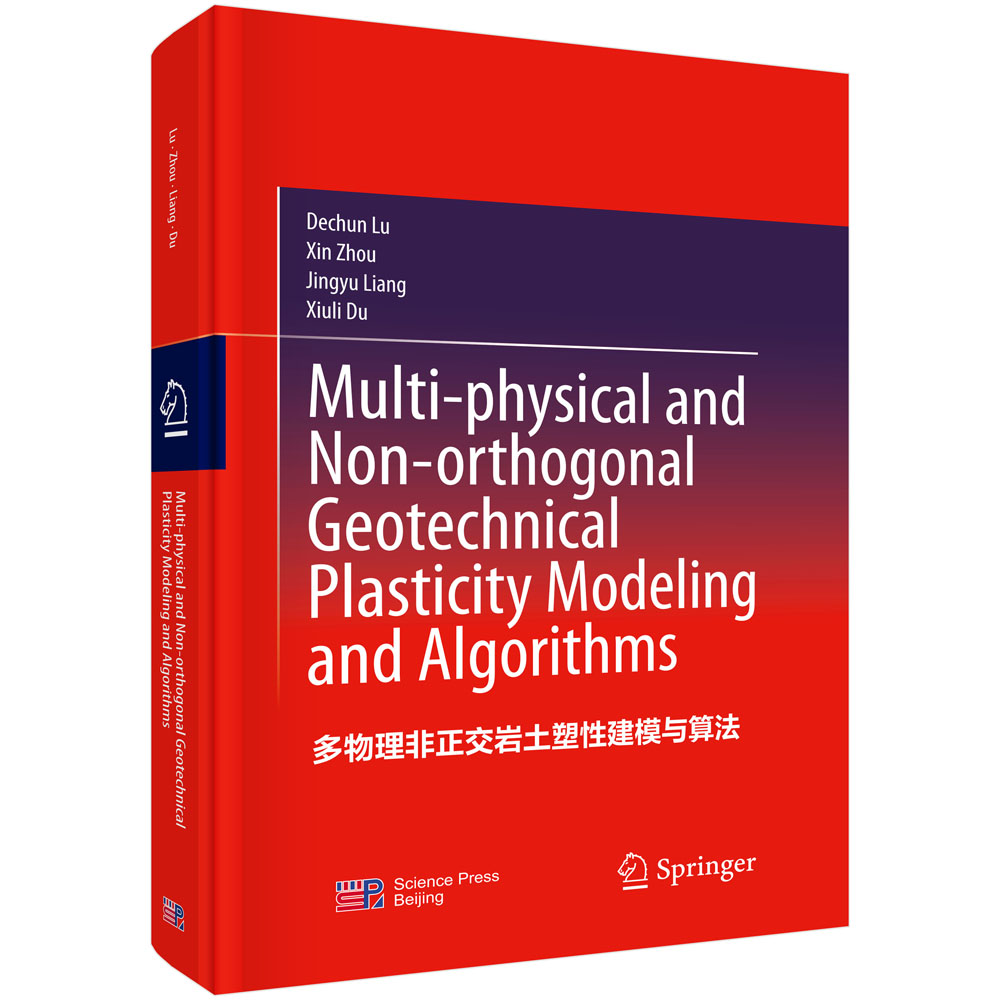
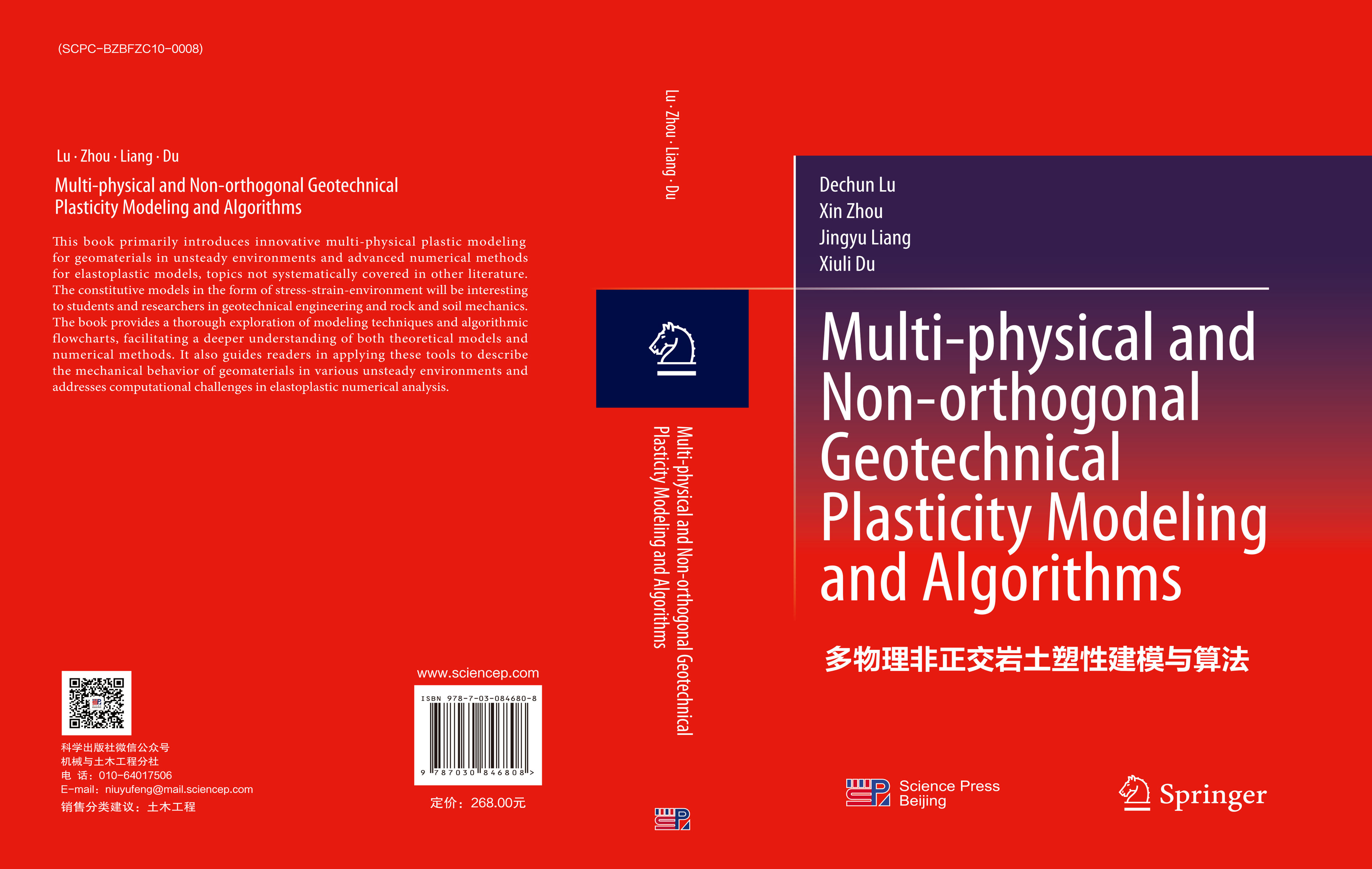
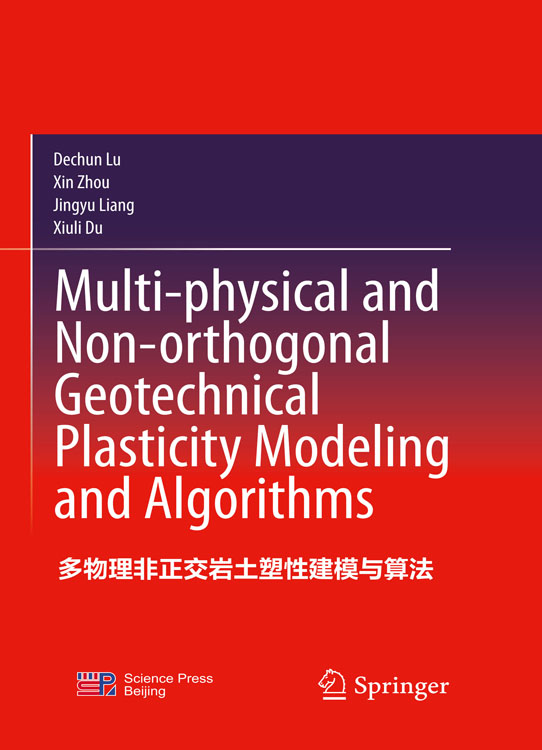
Multi-physical and Non-orthogonal Geotechnical Plasticity Modeling and Algorithms(多物理非正交岩土塑性建模与算法)



联系编辑
 
标题:
 
内容:
 
联系方式:
 
  
Multi-physical and Non-orthogonal Geotechnical Plasticity Modeling and Algorithms(多物理非正交岩土塑性建模与算法)

  • 书号:9787030846808
    作者:路德春,周鑫,梁靖宇,杜修力
  • 外文书名:
  • 装帧:圆脊精装
    开本:B5
  • 页数:298
    字数:
    语种:en
  • 出版社:科学出版社
    出版时间:2026-03-01
  • 所属分类:
  • 定价: ¥268.00元
    售价: ¥201.00元
  • 图书介质:
    纸质书

  • 购买数量: 件  可供
  • 商品总价:

相同系列
全选

内容介绍

样章试读

用户评论

全部咨询

本书系统地介绍了作者们在非稳态环境条件下多物理岩土塑性理论、模型及数值算法方面的研究工作。在本书的前半部分,首先介绍了一种严密的塑性建模方法,包括无需构造塑性势函数的非正交流动规则、确定非稳态环境下塑性应变增量和加/卸载准则、增量型应力-应变环境本构关系。基于该理论框架,作者们建立了一系列稳态和非稳态环境下的土和混凝土的非正交弹塑性模型,这些模型的性能得到了大量实验数据的充分验证。在本书的后半部分,作者基于前沿的数值方法,如数值优化算法、数值微分方法、正则化技术等,提出了一些高效、稳健的应力更新算法,用于解决弹塑性模型数值实现中常见的计算困难,这些算法在岩土材料弹塑性模型的数值应用中表现出了良好的性能。
样章试读
  • 暂时还没有任何用户评论
总计 0 个记录,共 1 页。 第一页 上一页 下一页 最末页

全部咨询(共0条问答)

  • 暂时还没有任何用户咨询内容
总计 0 个记录,共 1 页。 第一页 上一页 下一页 最末页
用户名: 匿名用户
E-mail:
咨询内容:

目录

  • Contents
    Chapter 1 Introduction 1
    1.1 Geotechnical Plasticity Modeling 2
    1.1.1 Magnitude of Plastic Strain Increment 3
    1.1.2 Direction of Plastic Strain Increment 6
    1.2 Stress Update Algorithms for Elastoplastic Models 8
    1.2.1 Numerical Techniques for Non-smooth Problems 8
    1.2.2 Numerical Methods for Nonlinear Problems 10
    1.2.3 Regularization Methods for Mesh Dependence Problem 11
    1.3 Main Research Work 11
    References 13
    Chapter 2 Multi-physical and Non-orthogonal Geotechnical Plasticity Theory 19
    2.1 Magnitude of Plastic Strain Increment 20
    2.2 Direction of Plastic Strain Increment 23
    2.2.1 Non-orthogonal Phenomena in Numerical Experiments 24
    2.2.2 Non-orthogonal Plastic Flow Rule 27
    2.3 Multi-physical Loading/Unloading Criterion 29
    2.4 Constitutive Equations of Multi-physical and Non-orthogonal Plasticity Theory 33
    2.5 Determination Method for Model Parameters 34
    2.6 Summary 36
    References 37
    Chapter 3 Non-orthogonal Elastoplastic Model for Soil in Steady Environments 39
    3.1 Characteristic Stress Method 40
    3.2 Non-orthogonal Elastoplastic Model for Clay 44
    3.2.1 Yield Function 44
    3.2.2 Direction of Plastic Strain Increment 45
    3.2.3 Magnitude of Plastic Strain Increment 53
    3.2.4 Stress-Strain Relationship 55
    3.2.5 Parameter Calibration and Model Validation 55
    3.3 Non-orthogonal Elastoplastic Model for Sand with Dilatancy 62
    3.3.1 Direction of Plastic Strain Increment 62
    3.3.2 Magnitude of Plastic Strain Increment 65
    3.3.3 Stress-Strain Relationship 72
    3.3.4 Parameter Calibration and Model Validation 73
    3.4 Summary 76
    References 78
    Chapter 4 Non-orthogonal Elastoplastic Model for Soil in Unsteady Water Environment 81
    4.1 Modeling Approach for Soil in Unsteady Water Environment 82
    4.2 Establishment of Constitutive Model 86
    4.2.1 Yield Function in Steady Water Environment 86
    4.2.2 Influence of Water Environment on Yield Function 88
    4.2.3 Description of Unsteady Water Environment 91
    4.3 Constitutive Equations 94
    4.4 Model Validation 97
    4.4.1 Silt Sand 97
    4.4.2 Pearl Clay 99
    4.4.3 Mixed Soil 104
    4.5 Model Performance Analysis 106
    4.5.1 Isotropic Compression Path with Constant Suction 107
    4.5.2 Wetting Path with Constant Net Stress 108
    4.5.3 Conventional Triaxial Drained Shearing Path 112
    4.6 Summary 113
    References 114
    Chapter 5 Non-orthogonal Plasticity Damage Model for Concrete 117
    5.1 Theoretical Framework of Plasticity Damage Model 118
    5.1.1 Damage Formulation 118
    5.1.2 Plasticity Formulation 119
    5.2 Specifics Adopted for Concrete Model 121
    5.2.1 Damage Variable 121
    5.2.2 Effective Hardening Function 123
    5.2.3 Yield Function 125
    5.2.4 Non-orthogonal Flow Rule 128
    5.3 Parameter Calibration and Model Validation 133
    5.3.1 Parameter Calibration 133
    5.3.2 Model Validation for Monotonic Loading 135
    5.3.3 Model Validation for Cyclic Loading 136
    5.4 Summary 139
    References 141
    Chapter 6 Non-orthogonal Elastoplastic Model for Concrete in Variable Strain Rate Environment 143
    6.1 Specifics Adopted for Concrete Model 144
    6.1.1 Yield Function 144
    6.1.2 Hardening Parameter 146
    6.1.3 Flow Rule 148
    6.1.4 Loading/Unloading Criterion 149
    6.2 Test of Loading Under Constant- and Variable-Strain Rate 149
    6.2.1 Testing Procedures and Apparatus 150
    6.2.2 Preparation of Materials and Specimens 150
    6.2.3 Experimental Results 151
    6.3 Comparison of Model Predictions and Test Results 153
    6.3.1 Constant-Strain Rate 153
    6.3.2 Variable-Strain Rate 156
    6.4 Analysis of Incremental Stress-Strain-Strain Rate Model 160
    6.4.1 Loading Paths with Independent Variation in Strain Rate 160
    6.4.2 Designed Variable-Strain Rate Loading Test 163
    6.5 Summary 164
    References 164
    Chapter 7 Unconstrained Stress Update Algorithm for Elastoplastic Models 167
    7.1 Implicit Stress Integral Scheme for Elastoplastic Models 168
    7.2 Return Mapping Stress Update Strategy 169
    7.3 Unconstrained Stress Update Strategy 170
    7.4 Application to 1D Compression Problem 171
    7.4.1 Return Mapping Stress Update Strategy Solution 172
    7.4.2 Unconstrained Stress Update Strategy Solution 175
    7.5 Application to Non-orthogonal Elastoplastic Model for Clay 176
    7.5.1 Implicit Stress Update Implementation 176
    7.5.2 Smoothing Consistent Tangent Operator 178
    7.6 Numerical Examples 183
    7.6.1 Cylindrical Cavity Expansion Problems 184
    7.6.2 Cylinder under Cyclic Shear Loads 186
    7.6.3 Foundation Bearing Capacity Test 187
    7.7 Summary 191
    References 194
    Chapter 8 Stress Update Algorithm Based on Numerical Optimization Methods 197
    8.1 Unconstrained Minimization Problem: Modified Cam-Clay Model Case 198
    8.2 Stress Update Algorithm with Line Search Method 200
    8.3 Stress Update Algorithm with Trust Region Method 203
    8.3.1 Trust Region Radius Determination 205
    8.3.2 Non-monotonic Trust Region Method 205
    8.3.3 Double Dogleg Method for Subproblem Solving 207
    8.4 Numerical Examples 210
    8.4.1 Element Test 210
    8.4.2 Strip Foundation under Inclined Load 213
    8.4.3 Cylinder under Cyclic Shear Loads 214
    8.5 Summary 219
    References 221
    Chapter 9 Stress Update Algorithm Based on Numerical Differentiation Methods 223
    9.1 Numerical Differentiation Methods 224
    9.2 Finite Difference Methods 224
    9.2.1 Complex Step Derivative Approximation 226
    9.2.2 Hyper-Dual Step Derivative Approximation 226
    9.2.3 Numerical Evaluation 229
    9.3 Implicit Stress Integral Scheme of Mohr-Coulomb Plasticity Model 229
    9.3.1 Non-associated Mohr-Coulomb Plasticity Model 230
    9.3.2 Implicit Stress Integration Scheme 233
    9.4 Return Mapping Algorithm Using Line Search Method and Hyper-Dual Step Derivative Approximation 234
    9.4.1 Solution of Nonlinear Equations Based on Line Search Method 234
    9.4.2 Derivative Evaluation Based on Hyper-Dual Step Derivative Approximation 236
    9.5 Numerical Evaluations 238
    9.5.1 3D Notched Plate Under Tension 240
    9.5.2 Cylinder Under Shear Loads 242
    9.5.3 Strip Footing on Slope 244
    9.5.4 Slope Stability Analysis 245
    9.5.5 Tunnel Excavation Simulation 247
    9.6 Summary 249
    References 251
    Chapter 10 Stress Update Algorithm Based on Integral Nonlocal Method 253
    10.1 Integral Type Nonlocal Method 254
    10.2 Nonlocal Implicit Stress Update Algorithm 256
    10.2.1 Plastic Part 257
    10.2.2 Damage Part 258
    10.2.3 Consistent Tangent Operator 259
    10.3 Application to Mohr-Coulomb Plasticity Damage Model 261
    10.3.1 Basic Constitutive Elements 261
    10.3.2 Nonlocal Numerical Implementation 265
    10.4 Numerical Examples 267
    10.4.1 2D Plate Plane Strain Compression Test 269
    10.4.2 3D Notched Plate Compression Test 269
    10.4.3 Concrete-Filled Steel-Tube Column under Central Compression 273
    10.4.4 Reinforced Concrete Column under Eccentric Compression 277
    10.4.5 3D Column Specimen Axial Compression Test 279
    10.5 Summary 281
    References 282
    Appendix A Definitions and Properties of Fractional Derivatives 285
    Appendix B Operation Rules and Numerical Implementation of Hyper-Dual Numbers 289
帮助中心
公司简介
联系我们
常见问题
新手上路
发票制度
积分说明
购物指南
配送方式
配送时间及费用
配送查询说明
配送范围
快递查询
售后服务
退换货说明
退换货流程
投诉或建议
版权声明
经营资质
营业执照
出版社经营许可证